🛡 Cyber Risk Intelligence Platform
A Unified Cyber Risk Intelligence Dashboard for Network Assessment, Human Risk Evaluation, and Security Awareness
Executive Summary
The Cyber Risk Intelligence Platform is a Flask-based cybersecurity dashboard developed to provide a unified view of both technical and human cyber risks.
Instead of relying on multiple standalone tools, the platform combines network scanning, email breach detection, phishing awareness, cyber risk scoring, historical reporting, and security recommendations into a single interface.
The objective of the project is to help users quickly understand their overall security posture while promoting proactive cybersecurity practices.
Project Highlights
| Feature | Status |
|---|---|
| Local IP Detection | ✅ |
| Nmap Network Scanning | ✅ |
| Open Port Identification | ✅ |
| Running Service Detection | ✅ |
| Email Breach Checking | ✅ |
| Phishing Awareness Simulation | ✅ |
| Cyber Risk Score Calculation | ✅ |
| Threat Level Classification | ✅ |
| Historical Scan Records | ✅ |
| PDF Report Generation | ✅ |
Project Preview
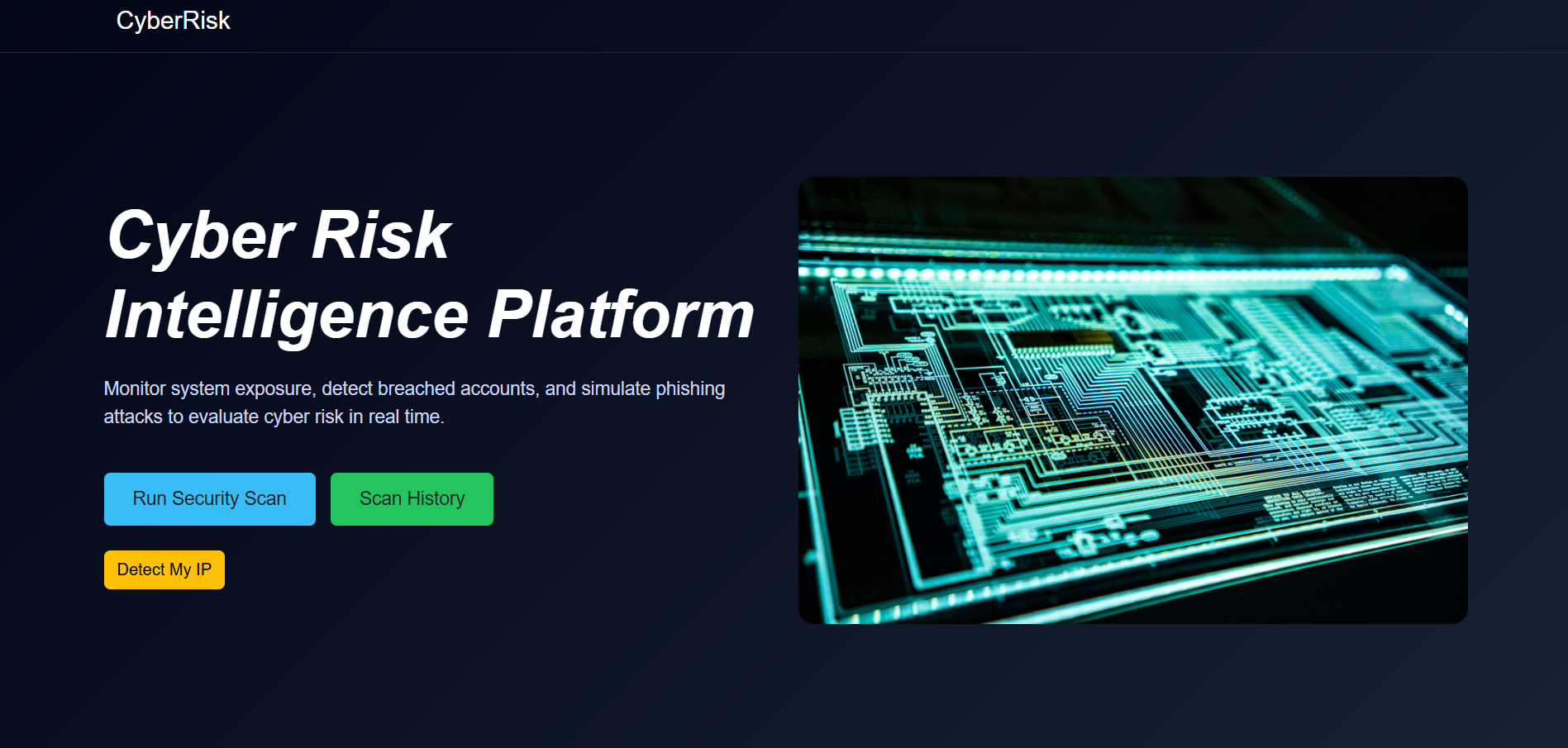
Project Overview
Modern organizations often rely on multiple security tools to evaluate different aspects of cybersecurity.
The Cyber Risk Intelligence Platform consolidates multiple security assessment techniques into one dashboard, enabling users to evaluate technical vulnerabilities and human cyber risks from a single interface.
The platform performs automated analysis, generates a Cyber Risk Score, stores assessment history, and provides practical recommendations to improve overall security posture.
Problem Statement
Security assessments are often performed using multiple independent tools. Network scanners identify exposed services, breach-checking platforms verify compromised accounts, and phishing awareness is usually evaluated separately.
Switching between these tools makes it difficult to obtain a consolidated view of an individual's or organization's overall cyber risk.
The Cyber Risk Intelligence Platform addresses this challenge by integrating multiple security assessment techniques into a single dashboard, allowing users to perform a comprehensive security evaluation from one interface.
System Architecture
The platform follows a modular workflow where each component performs a dedicated security task before contributing to the final Cyber Risk Score.
                 User
                   │
                   ▼
        Cyber Risk Dashboard
                   │
    ┌──────────────┼──────────────┐
    │              │              │
    ▼              ▼              ▼
Local IP      Email Breach     Phishing
Detection        Check         Assessment
    │              │              │
    └──────┬───────┴───────┬──────┘
           ▼               ▼
      Nmap Network     Risk Engine
          Scan
           │
           ▼
   Open Ports & Services
           │
           ▼
  Cyber Risk Score Engine
           │
           ▼
 Security Recommendations
           │
           ▼
  History + PDF Report
Core Features
🌐 Network Discovery
- Automatically detects the local system IP address.
- Performs network scanning using Nmap.
- Identifies open ports and running services.
- Collects information required for risk analysis.
🔍 Service Enumeration
The platform analyses discovered services and displays:
- Open TCP ports
- Running services
- Potential attack surface
- Security recommendations
This helps users understand which services may require additional hardening.
📧 Email Breach Detection
Users can verify whether an email address has appeared in publicly known data breaches.
This feature increases awareness of compromised credentials and encourages users to strengthen account security.
🎣 Phishing Awareness Assessment
The platform includes a phishing awareness module designed to evaluate user responses during simulated phishing scenarios.
The results contribute to the overall Cyber Risk Score, demonstrating that human behaviour is an important component of cybersecurity.
📊 Cyber Risk Score
Instead of displaying isolated findings, the platform combines multiple security indicators into a single Cyber Risk Score.
The score is calculated using factors such as:
- Open network services
- Email breach status
- Phishing awareness results
- Overall exposure level
The final score is accompanied by a risk classification and actionable recommendations.
📄 Security Reporting
The platform provides:
- Historical scan records
- Risk assessment summaries
- Security recommendations
- Exportable PDF reports
These reports help users track security improvements over time.
Technology Stack
| Layer | Technology |
|---|---|
| Programming Language | Python |
| Backend Framework | Flask |
| Frontend | HTML, CSS, JavaScript |
| Network Scanning | Nmap |
| Database | SQLite |
| Risk Analysis | Custom Risk Engine |
| Reporting | PDF Generation |
| Version Control | Git & GitHub |
Project Workflow
The Cyber Risk Intelligence Platform follows a structured workflow to perform a comprehensive security assessment.
Start
   │
   ▼
Detect Local IP
   │
   ▼
Run Nmap Scan
   │
   ▼
Identify Open Ports & Services
   │
   ▼
Check Email Breach Status
   │
   ▼
Evaluate Phishing Awareness
   │
   ▼
Calculate Cyber Risk Score
   │
   ▼
Generate Security Recommendations
   │
   ▼
Store Scan History
   │
   ▼
Generate PDF Report
   │
   ▼
Finish
The workflow combines multiple security checks into a single assessment pipeline, enabling users to understand both technical vulnerabilities and human-related cyber risks.
Dashboard Gallery
The following screenshots demonstrate the different modules available in the platform.
🏠 Home Dashboard
The dashboard serves as the central interface where users can initiate security assessments and review overall security posture.
🔍 Security Scan
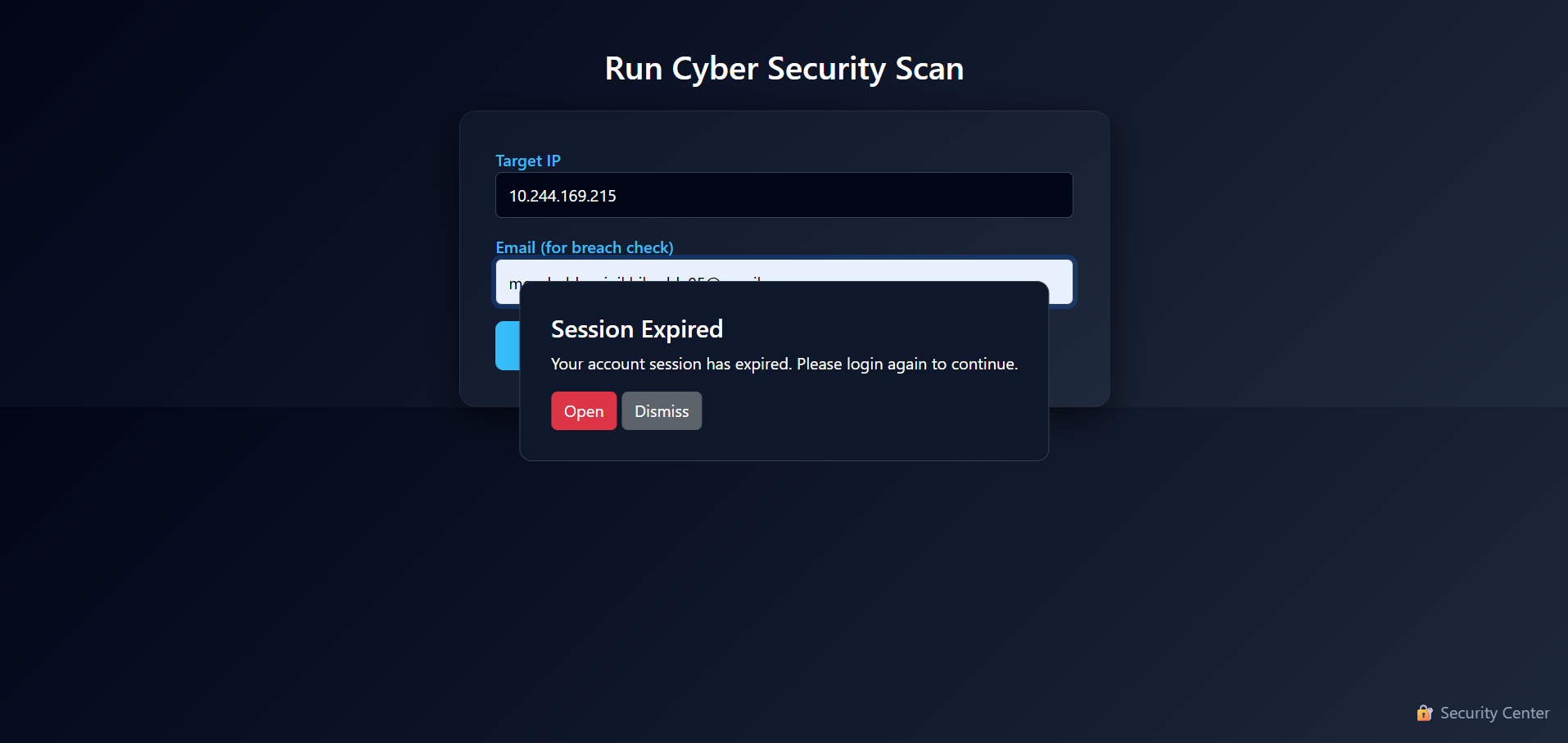
Displays detected open ports, identified services, scan duration, and security observations obtained through Nmap.
📈 Risk Assessment
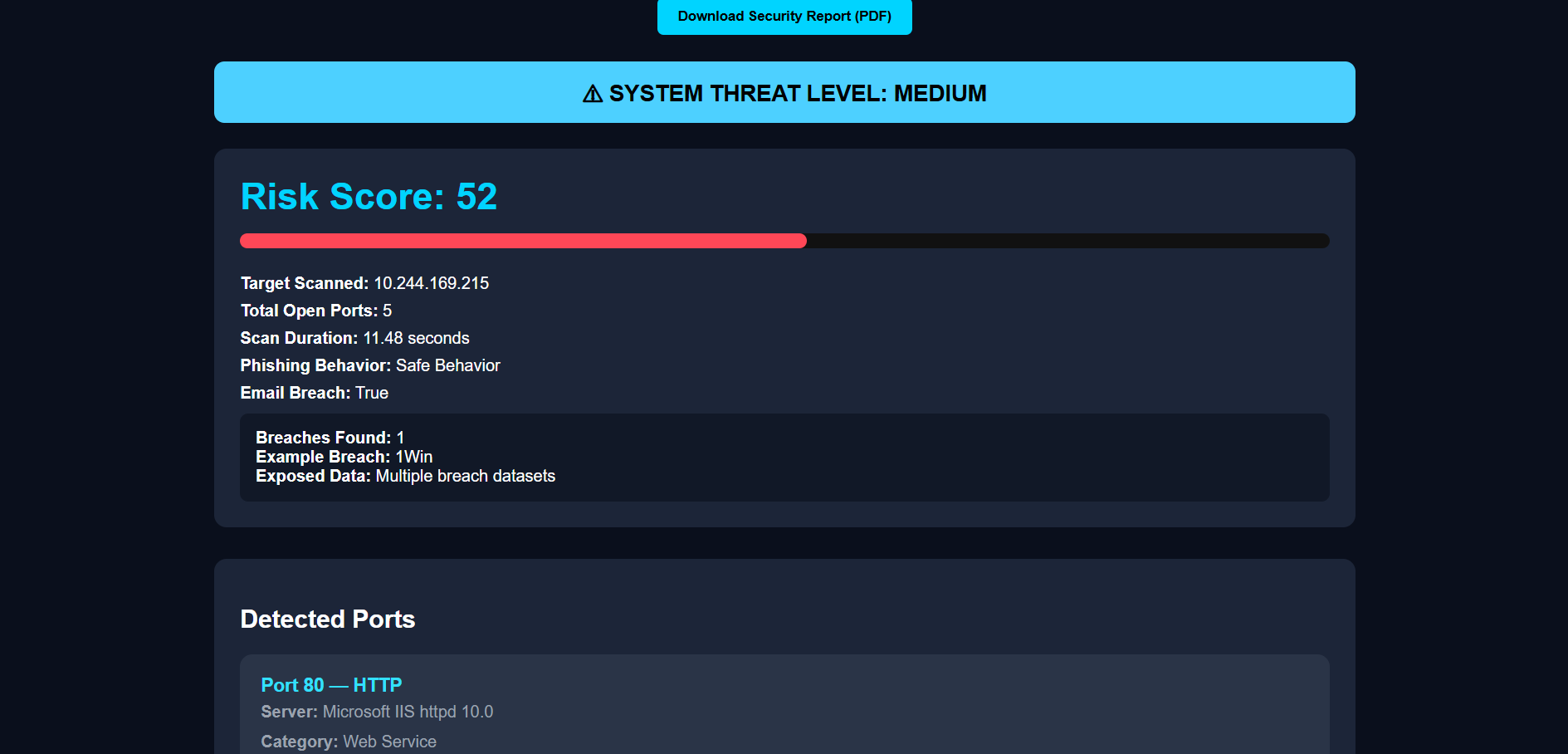
Combines technical findings and user assessment results to generate an overall Cyber Risk Score with appropriate risk classification.
🗂 Scan History
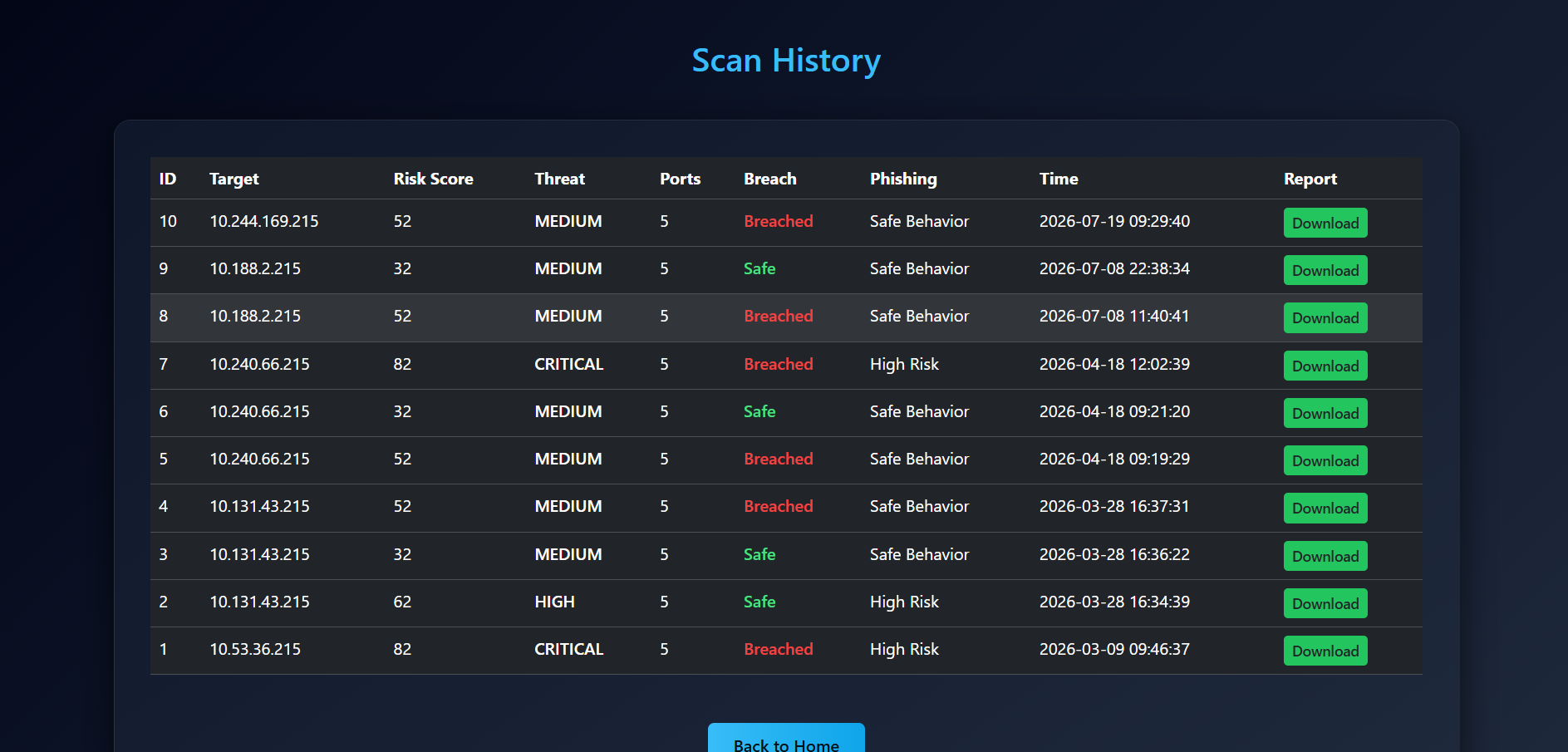
Stores previous assessments, allowing users to review historical security reports and compare results over time.
Challenges & Solutions
| Challenge | Solution |
|---|---|
| Combining multiple security modules into one dashboard | Designed a modular Flask application with independent security components |
| Collecting network information automatically | Integrated Nmap for automated scanning and service detection |
| Presenting technical results in a user-friendly format | Built a centralized dashboard with structured risk summaries |
| Measuring overall cyber exposure | Developed a custom Cyber Risk Score based on multiple security indicators |
| Maintaining previous assessments | Implemented SQLite storage for historical scan records |
Skills Demonstrated
Throughout this project, the following practical skills were applied:
- Python application development
- Flask web development
- Network reconnaissance
- Nmap integration
- Cyber risk assessment
- Security dashboard development
- Email breach verification
- Phishing awareness concepts
- SQLite database integration
- PDF report generation
- Cybersecurity automation
- Technical documentation
- Git & GitHub version control
Future Enhancements
Planned improvements for future versions include:
- CVE database integration
- Automated vulnerability severity mapping
- Threat Intelligence API integration
- Authentication and user management
- Interactive analytics dashboard
- Real-time security alerts
- Email notification support
- Enhanced reporting and visualization
- Multi-user support
- Cloud deployment
Repository & Resources
💻 Source Code
GitHub Repository
https://github.com/sainikhilreddymondeddu/CyberRiskPlatform
🎥 Demonstration Video
Project Walkthrough
https://drive.google.com/file/d/1-42ioroBQQqNi41v2AITZW2yh189SXLY/view
Conclusion
The Cyber Risk Intelligence Platform demonstrates the practical application of cybersecurity concepts by integrating network scanning, breach detection, phishing awareness, risk analysis, reporting, and historical tracking into a unified web application.
The project reflects practical experience in cybersecurity automation, secure application development, and security assessment while providing a scalable foundation for future enhancements.